August 24, 2011

FOOTWEAR EVIDENCE IN FORENSICS

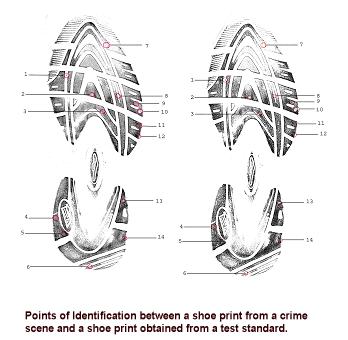
Footwear track evidence can be very instrumental to the successful conclusion of a criminal investigation.Detailed examination of footwear impressions can help to link a specific piece of footwear to a footwear imprint as each shoe will have unique wear characteristics.
Photographing Footwear Evidence
Written by Dwane Hilderbrand
Taking quality examination photographs
When making quality examination photographs of the evidence prints, be sure to use the same numbered marker you used when you were showing the relationship of the print to the scene. In order for a footwear examiner to perform a quality examination, high-quality, close-up photographs are required. Since footwear evidence can come in two different forms—prints and impres-sions—the techniques of photography are slightly different. This can be easily obtained with a little time and patience. There are many types of cameras that are being used for crime-scene photo-graphy, ranging from 35 mm and 4 x 5 film cameras to digital cameras.


After the selection of the camera and the film or digital media, you will need to select an appropriate scale that will be present in all the photographs. This is very critical in order to allow for enlargement from the negative or image to make an exact duplicate of size (1:1). When no scale is utilized in the photograph, the examiner has no idea what the size of the real impression is. It then becomes difficult for the forensic photographer to print 1:1 scale photographs for examination purposes.

Types of footwear evidence
Footwear evidence can come in at least 3 forms, footwear outsole impression evidence, footwear insole impressions and footwear trace evidence.

Footwear outsole impression
Footwear outsole impressions are impressions left on an object that was caused by contact with a piece of footwear. These can left on the ground or raised surface by persons treading over it, left on doors or walls by persons attempting to kick or climb over a wall or even left on other persons after being kicked or stomped on.

Latent footwear outsole impressions:
Latent impressions are caused impressions that are not easily visible to naked eye. Such prints can be on many different surfaces such as floor tiles, concrete or even carpet. Latent impression may not be easily visible to the naked eye and its detection may require the use of additional specialized light sources such as portable UV lighting. Recovery typically includes photography as well as lifting with “gel” or “electrostatic” dust lifters.

Footwear Insole imprints

Footwear insole imprints are imprints left in the inside of footwear caused by contact from the person’s foot. Analysis of the insole imprints can be used to link a person(s) to a piece of footwear.

Footwear trace evidence

Footwear trace evidence is trace evidence that is recovered from footwear. Types of trace evidence that could be recovered include skin, glass fragments, body hair, fibres from clothing or carpets, soil particles, dust and bodily fluids. 

The study of this trace evidence could be used to link a piece of footwear to a location or owner.
Detection of footwear evidence
Detection of impression in ambient lighting
Detection with forensic light sources
Detection with electrostatic lifting devices
Detection with chemical enhancement

COURSES IN FOOTWEAR EVIDENCE:


FEW LINKS:

August 20, 2011

Forensic Saliva Analysis

Body fluids, whether excreted or secreted, help our forensic experts compile detailed reports on sexual assaults, death, and the identification of attackers among other things.A forensic investigation can involve the analysis of body fluids, including saliva, for evidence of toxins and both prescription and illicit drugs.Saliva can be of forensic significance because traces of drugs that are circulating in the body can be present in saliva. The composition of the saliva accurately mirrors the proteins that are present in both the blood and the urine. Thus, testing of saliva, which is easier and less obtrusive than obtaining a blood or urine sample, can be used to reveal the presence of prescription and illicit drugs.


Saliva is presented as an alternative matrix in the establishment of drug abuse. The ultimate salivary concentration is determined by the route of administration, the salivary pH, the degree of plasma protein binding,and the physico-chemical properties of the abused drug. Since the saliva/plasma ratio can exceed 1, saliva might be a better analytical tool than blood during roadside testing of potentially intoxicated drivers

Virkler and Lednev add that Raman spectroscopy has great potential as just such a non-destructive tool. In 2008, the team reported that it could be used to identify bodily fluids at a crime scene but those experiments were carried out with just a single sample of each type of fluid. Now, the team has extended the work significantly to investigate the potential for spectroscopic differences among different “donors” of the same fluid.
The researchers have used near-infrared (NIR) Raman spectroscopy to obtain spectra for pure dried human saliva samples from several donors in a controlled laboratory environment. By applying principal component analysis (PCA) on the spectra they demonstrated that dry saliva is a particularly heterogeneous substance. However, the Raman spectra can be described as being a linear combination of a fluorescent background and three spectroscopic components.

Forensic Preliminary Testing for Saliva (amylase)

Phadebas tablet method
1. Place 50 ul of each described dilution from above into a
test tube.
2. Add 1.0 ml of water, and ¼ Phadebas tablet (cut with scalpel
or razor blade CAREFULLY). Add the ¼ tablet using
forceps, NOT fingers to handle/cut the tablet.
3. Vortex to mix thoroughly.
4. Incubate at 37C for 30 minutes.
5. Add .25 ml of 0.5 M Sodium Hydroxide to each tube to stop
the reaction.
6. Centrifuge for 5 minutes.
7. A transparent dark blue supernatant
LATEST!!- New Forensics Tool Can Determine a Person’s Age from a Spit Sample
Researchers at UCLA have figured out how to determine age to within five years from nothing more than a saliva sample. The method relies on a process called methylation, which is a chemical change to one of the four building blocks of a person’s DNA. Methylation changes as our bodies grow older, contributing to age related diseases. In extracting DNA from saliva samples from more than 100 test subjects, the team found that it could zero in on a person’s age within five years by looking at just two of the 3 billion blocks that make up the human genome–such is the strong correlation between methylation and age.

References:

1. Enotes
2. Sourcebook in forensic serology, immunology, and biochemistry
3. Scientific Protocols for Forensic Examination of Clothing (Protocols in Forensic Science)
4. Forensic Biology: Identification and DNA Analysis of Biological Evidence

August 8, 2011

Are you in the Right Flight??

Dexter- Has got his Blood Splatter Analysis done! What About You??…. Yes Guys! This is where blood takes flight and we as forensic scientist need to know the Direction of Flight- i.e The trajectory of a blood drop which can be established by its angle of impact and directionality angle.


Now you need to know the basics in Direction in Blood Splatter. Here are few terminologies:

Draw-Back Effect – Blood in the barrel of a firearm that has been drawn backward into the muzzle.

Drip Pattern — A bloodstain pattern which results from blood dripping into blood.

Expirated Blood – Blood that is blown out of the nose, mouth, or a wound as a result of air pressure and/or air flow which is the propelling force.

Flight Path – The path of the blood drop, as it moves through space, from the impact site to the target.

Flow Pattern – A change in the shape and direction of a bloodstain due to the influence of gravity or movement of the object.

Forward Spatter – Blood which travels in the same direction as the source of energy or force which caused the spatter.

High Velocity Impact Spatter (HVIS) — A bloodstain pattern caused by a high velocity impact /force to a blood source such as that produced by gunshot or high speed machinery.

Impact Pattern – Bloodstain pattern created when blood receives a blow or force resulting in the random dispersion of smaller drips of blood.

Impact Site — That point where force encounters a source of blood.

Low Velocity Impact Spatter (LVIS) – A bloodstain pattern that is caused by a low velocity impact/force to a blood source.

Medium Velocity Impact Spatter (MVIS) – A bloodstain pattern caused by a medium velocity impact/force to a blood source. A beating typically causes this type of spatter.

Passive Drop (Bleeding) – Bloodstain drop(s) created or formed by the force of gravity acting along.

Point (Area) of Convergence – The common point (area), on a two dimensional surface, over which the directionality of several blood drops can be retraced.

Point (Area) of Origin — The common point (area) in a three dimensional space to which the trajectories of several blood drops can be retraced.

Projected Blood Pattern — A bloodstain pattern that is produced by blood released under pressure as opposed to an impact, such as arterial spurting

Angle of Impact: The steeper the impact, the more elliptical or elongated, the blood drop

For a complete list of bloodstain pattern terms, as recommended by the International Association of
Blood Stain Pattern Analysts. (IABPA), go to: http://www.iabpa.org/
These terms should serve as a guide, for those who work and teach in the field of Blood Stain Pattern Analysis


July 28, 2011

FORENSIC DNA

DNA typing, since it was introduced in the mid-1980s, has revolutionized forensic science and the ability of law enforcement to match perpetrators with crime scenes. Thousands of cases have been closed and innocent suspects freed with guilty ones punished because of the power of a silent biological witness at the crime scene.
DNA technologies used in forensic investigations

Restriction Fragment Length Polymorphism (RFLP)
RFLP is a technique for analyzing the variable lengths of DNA fragments that result from digesting a DNA sample with a special kind of enzyme. RFLP was one of the first applications of DNA analysis to forensic investigation.

PCR Analysis

Polymerase chain reaction (PCR) is used to make millions of exact copies of DNA from a biological sample. DNA amplification with PCR allows DNA analysis on biological samples as small as a few skin cells.

STR Analysis

Short tandem repeat (STR) technology is used to evaluate specific regions (loci) within nuclear DNA. Variability in STR regions can be used to distinguish one DNA profile from another.

Mitochondrial DNA Analysis

Mitochondrial DNA analysis (mtDNA) can be used to examine the DNA from samples that cannot be analyzed by RFLP or STR.

Y-Chromosome Analysis

The Y chromosome is passed directly from father to son, so analysis of genetic markers on the Y chromosome is especially useful for tracing relationships among males or for analyzing biological evidence involving multiple male contributors.


July 7, 2011

Forensic Arson Analysis

When detectives arrive at the scene of a fire, the first thing that they do is interview any witnesses to the fire, for example, the person who called the fire brigade and those who arrived before the fire department, whom may have seen how the fire began. When the fire has been controlled, the temperature falls, allowing the firefighters to make the building safe for investigation.  Similar to burglary and theft, arson is also a crime of stealth. The perpetrator of arson does not want to be seen committing his cowardly act. Most arson fires, therefore, occur at night and normally when no one is in the structure. Arson-for-profit is usually planned well ahead and the insured usually has a solid alibi far from the scene. 


 The investigation into how the fire started involves beginning at the lower levels, as fire travels upwards. The signs investigators search for when looking for the place the fire may have started include lingering heat, how deep the charring is, the flaking of building materials like cement and plaster, distorted plastic, metal and glass resulting from prolonged burning, damaged ceiling and structural damage.Samples are sealed in airtight containers and then tested for residues of accelerant liquid that might have been used to start the fire. These are the most common tests performed by forensics labs during an arson investigation:
  • Static headspace heats the sample, causing the residue to separate out and vaporize into the top, or "headspace" of the container. That residue is then injected into a gas chromatograph, where it's broken apart to analyze its chemical structure.
  • Passive headspace heats the sample and the residue collects onto a carbon strip in the container. Then the residue collected is injected into a gas chomatograph/mass spectrometer for analysis.
  • Dynamic headspace bubbles liquid nitrogen gas through the sample and captures the residue onto an absorbent trap. The trapped compounds are then analyzed using gas chromatography.
References:
  1. How Stuff Works
  2. Fire Cops: On the Case with America's Arson Investigators
  3. Fire Investigator Field Guide
  4. Thinkquest team

Forensic Saliva Analysis

Body fluids, whether excreted or secreted, help our forensic experts compile detailed reports on sexual assaults, death, and the identification of attackers among other things.A forensic investigation can involve the analysis of body fluids, including saliva, for evidence of toxins and both prescription and illicit drugs.Saliva can be of forensic significance because traces of drugs that are circulating in the body can be present in saliva. The composition of the saliva accurately mirrors the proteins that are present in both the blood and the urine. Thus, testing of saliva, which is easier and less obtrusive than obtaining a blood or urine sample, can be used to reveal the presence of prescription and illicit drugs.

 Saliva is presented as an alternative matrix in the establishment of drug abuse. The ultimate salivary concentration is determined by the route of administration, the salivary pH, the degree of plasma protein binding,and the physico-chemical properties of the abused drug. Since the saliva/plasma ratio can exceed 1, saliva might be a better analytical tool than blood during roadside testing of potentially intoxicated drivers

 Virkler and Lednev add that Raman spectroscopy has great potential as just such a non-destructive tool. In 2008, the team reported that it could be used to identify bodily fluids at a crime scene but those experiments were carried out with just a single sample of each type of fluid. Now, the team has extended the work significantly to investigate the potential for spectroscopic differences among different "donors" of the same fluid.
The researchers have used near-infrared (NIR) Raman spectroscopy to obtain spectra for pure dried human saliva samples from several donors in a controlled laboratory environment. By applying principal component analysis (PCA) on the spectra they demonstrated that dry saliva is a particularly heterogeneous substance. However, the Raman spectra can be described as being a linear combination of a fluorescent background and three spectroscopic components.

New Forensics Tool Can Determine a Person's Age from a Spit Sample

Researchers at UCLA have figured out how to determine age to within five years from nothing more than a saliva sample.

The method relies on a process called methylation, which is a chemical change to one of the four building blocks of a person’s DNA. Methylation changes as our bodies grow older, contributing to age related diseases. In extracting DNA from saliva samples from more than 100 test subjects, the team found that it could zero in on a person’s age within five years by looking at just two of the 3 billion blocks that make up the human genome--such is the strong correlation between methylation and age.


References:
  1. Enotes
  2. Sourcebook in forensic serology, immunology, and biochemistry
  3. Scientific Protocols for Forensic Examination of Clothing (Protocols in Forensic Science)
  4. Forensic Biology: Identification and DNA Analysis of Biological Evidence

Featured Post

IFO ANNOUNCES - TRAINING PROGRAMS 2017