A technique that shows evidence of animals buried beneath green spaces decades ago could be used to help find human remains.
"Hyperspectral imaging" analyses visible and infrared images taken by aircraft and detects changes in vegetation caused by nutrients released from decomposing bodies.
Forensic archaeologists from McGill University in Montreal, Canada, tested the technique at a Quebec safari park and detected differences in chlorophyll content of plants growing on known burial sites. The findings, presented at the American Academy of Forensic Sciences annual meeting in February, were reported in New Scientist.
A UK forensic archaeologist, Ian Hanson of the University of Bournemouth, said the method could help find mass graves in war zones.
His team has researched how maggots feeding on buried carcasses can raise soil temperature enough to be detected by infrared, even when the body has lost its own heat.
April 16, 2010

April 15, 2010
A Really ODD Solution

For anyone who has spent a significant amount of time in an urban setting, the scene of a bomb squad responding to a report of a suspicious package might be all too familiar. But just how is it determined that the lunchbox left under the park bench is just leftovers - or a lethal weapon? The most common way is spectroscopy.
"Spectroscopy is good, but it only gets you so far," says Eric Houser, a program manager in the Explosives Division of the Department of Homeland Security's Science and Technology Directorate (S&T). The wave of the future may lie in a technology called optimal dynamic detection (ODD), which overcomes many of spectroscopy's limitations.
Spectroscopy uses the color spectrum to shed light on a package's makeup. Since it uses visible light only, spectroscopy can't see through a lunchbox, but what it can see is microscopic residue on the box's outer layer, which can provide telltale clues about what's inside.
Using spectroscopy, bomb squad personnel will beam a laser at the package, then compare the reflected "light signature"-an optical fingerprint-against a library of known signatures for chemical compounds, such as nitroglycerin. If there is nitro inside, chances are that some of it will be found in the package's residue.
This method presents two problems. First, there's distance. Many threat detection methods require either the person or the detector to be physically near the bomb, making spectroscopy extremely dangerous.
Second, approaches like spectroscopy, which rely on reflected light, often are not sensitive or selective enough, especially in the real world where chemical signatures may overlap or be contaminated. Think of light signatures as fingerprints. Capturing a fingerprint from a clean surface is not especially difficult. But in real life, surfaces are anything but clean, and dust, grease, or even ink stains can cause a backpack or lunch pail to bear small deposits of several different chemicals, each with a unique optical fingerprint. To minimize false alarms, a detector must be both sensitive and selective.
Source: Forensic Report
Read the entire article here :)
April 14, 2010
Forensic DNA blow to commercial whaling proposals
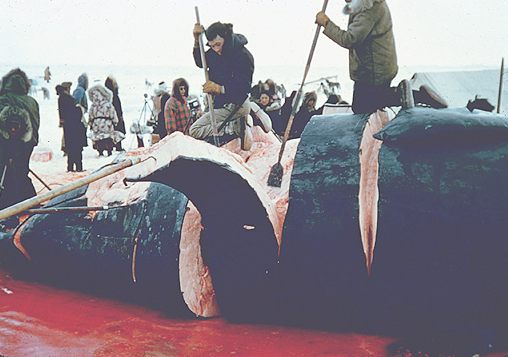
Proposals to resume commercial whaling have been dealt a blow by DNA detective work showing that restaurants in the US and South Korea illegally sold whale meat from Japan.
In June, Japan, Iceland and Norway are expected to ask the International Whaling Commission (IWC) for permission to resume commercial whaling. They say they can prevent smuggling by matching the DNA of whale meat sold in markets to a register of all legally caught whales. But all have refused to make their DNA registers public.
To find out the origin of whale meat being sold outside Japan, Scott Baker of Oregon State University in Corvallis and colleagues secretly took samples from two restaurants, one in Santa Monica, California, and another in Seoul, South Korea.
They compared the DNA with that from samples bought in Japan, and found that they came from the same animals – proving that meat from whales hunted in Japan's scientific programme have been illegally sold abroad. The findings resulted in police raids on the restaurants last month.
Read this Article here:NewScientist
April 13, 2010
IFO TURNS ONE TODAY!! :)

Dear All,
IFO turns one today on April,13, 2010!!
We are glad to announce that today April, 13, 2010 is the day we celebrate our one year of existence. Ifo Forensic Standards and Research Pvt Ltd have come across a young class of Forensic Experts who have been in a continuous stride to bring its forensic objectives in the limelight.
We have Launched our Celebration Issue of IFSR Times;E-Magazine- "Forensic Silhouette" on this auspicious occasion.
Please visit the following link to the E-Mag.
http://www.ifsr.in/press/
Thank you one and all for your continuous support.
--
Regards,
IFO Forensic Experts
IFSR Pvt Ltd. Delhi. India
Contact:011-26320016
Web: www.ifsr.in
One in four DNA profiles could be of innocents
At least one in four DNA profiles being collected by the police are for innocent people, a study has suggested.
Figures obtained under the Freedom of Information show that of 4,668 DNA profiles obtained by Cumbria police between December 2008 and January this year 1,319 people – or 28 per cent – had no further action taken against them. However only 12 profiles have since been deleted.
The picture is very different in Scotland. Strathclyde Police collected 19,197 profiles over the same period, of which 6,856 (36 per cent) were for people who were subsequently not convicted. All those profiles have been deleted.
The two forces were the only ones among the 49 covering England, Wales and Scotland who said they were able to supply figures for how many innocent people were being kept on the database.
The remaining forces claimed it would require too much work to compare DNA files with records on the Police National Computer, which would show the outcome of arrests.
Campaign group Big Brother Watch, which submitted the FOI request, warned that under current system it is virtually impossible to comply with new laws, required under the European human rights rules, that demand records of innocent people be removed after six months.
Dylan Sharpe, campaign director of Big Brother Watch, said: "Up to a third of DNA profiles added each year belong to people who have never committed a crime, yet the system currently being used in England and Wales makes it virtually impossible for the police to delete innocent profiles from the National Database.
"This contravenes the European Court ruling and represents a significant intrusion into our personal privacy.
Source: Telegraph.co.uk
Figures obtained under the Freedom of Information show that of 4,668 DNA profiles obtained by Cumbria police between December 2008 and January this year 1,319 people – or 28 per cent – had no further action taken against them. However only 12 profiles have since been deleted.
The picture is very different in Scotland. Strathclyde Police collected 19,197 profiles over the same period, of which 6,856 (36 per cent) were for people who were subsequently not convicted. All those profiles have been deleted.
The two forces were the only ones among the 49 covering England, Wales and Scotland who said they were able to supply figures for how many innocent people were being kept on the database.
The remaining forces claimed it would require too much work to compare DNA files with records on the Police National Computer, which would show the outcome of arrests.
Campaign group Big Brother Watch, which submitted the FOI request, warned that under current system it is virtually impossible to comply with new laws, required under the European human rights rules, that demand records of innocent people be removed after six months.
Dylan Sharpe, campaign director of Big Brother Watch, said: "Up to a third of DNA profiles added each year belong to people who have never committed a crime, yet the system currently being used in England and Wales makes it virtually impossible for the police to delete innocent profiles from the National Database.
"This contravenes the European Court ruling and represents a significant intrusion into our personal privacy.
Source: Telegraph.co.uk
April 12, 2010
Amazing killer blast clues from British scientist's breakthrough
AMAZING forensic research pioneered in Britain is being used to track down Taliban bombers - by the fingerprints found on their devices AFTER they've blown up.
Dr John Bond, a researcher at the University of Leicester, developed the technique to uncover prints from blast shrapnel and bomb casings.
It means allied troops in Afganistan can now establish exactly who made a deadly improvised explosive device - then hunt out their hiding places.
The technique is already used worldwide to help identify suspects in cold case murder investigations by analysing bullet shell casings.
Now the US Naval Criminal Investigation Service (NCIS) has adopted it in Iraq and Afghanistan to build up a database of the bombers who have killed hundreds of troops and military personnel with their crude, home-made roadside bombs.
Tests were first carried out in Iraq, to check if the Middle East's climate would cause problems to prints left by marines on brass and copper. Dr Bond explained: "By applying an electric charge to metal coated in a fine conducting powder, like that used in photocopiers, we can get a detailed print.
Source: News of the world
Dr John Bond, a researcher at the University of Leicester, developed the technique to uncover prints from blast shrapnel and bomb casings.
It means allied troops in Afganistan can now establish exactly who made a deadly improvised explosive device - then hunt out their hiding places.
The technique is already used worldwide to help identify suspects in cold case murder investigations by analysing bullet shell casings.
Now the US Naval Criminal Investigation Service (NCIS) has adopted it in Iraq and Afghanistan to build up a database of the bombers who have killed hundreds of troops and military personnel with their crude, home-made roadside bombs.
Tests were first carried out in Iraq, to check if the Middle East's climate would cause problems to prints left by marines on brass and copper. Dr Bond explained: "By applying an electric charge to metal coated in a fine conducting powder, like that used in photocopiers, we can get a detailed print.
Source: News of the world
April 10, 2010
.jpg)
Subscribe to:
Posts (Atom)
Featured Post

-
IFO FORENSIC STANDARDS AND RESEARCH PVT LTD (NEW DELHI), INDIA IFO is registered forensic and investigative Company, it is a panel of expert...
-
 A forensic expert witness is a type of expert witness who would provide expert forensic testimony within a trial.Many criminal and civil in...

